X-Ray Before You Wreck: What a Pre-Demolition Survey Actually Finds
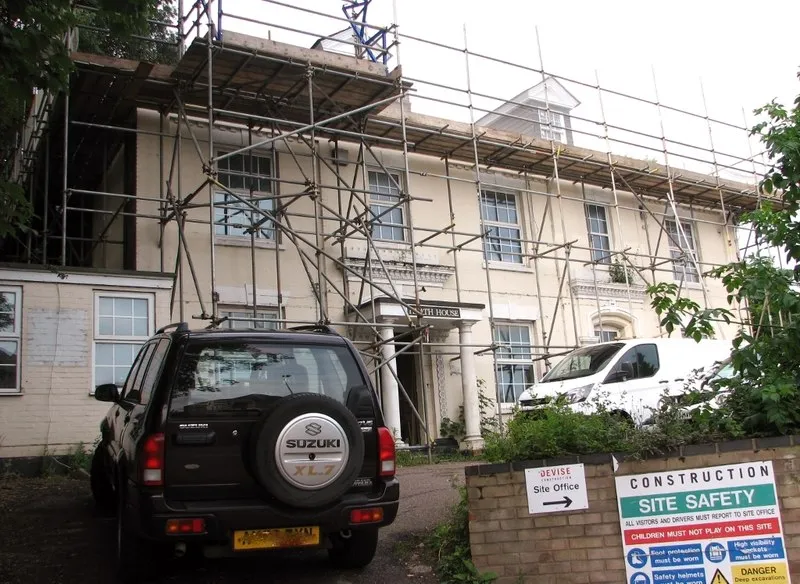
Photo: Evelyn Simak , CC BY-SA 2.0, via Wikimedia Commons
There's a moment on nearly every refurb where someone hits a wall with a bolster and says, "we'll find out what's in there when we open it up." It's said cheerfully. It's also where a lot of budgets go to die.
A refurbishment and demolition survey does the opening up before the money is committed. Not the quick walk-round your mortgage lender wanted, not the checklist a landlord does with a clipboard — a proper intrusive look at what the building is actually made of, what's buried in it and what has to be handled specially when it comes out.
It is, in plain terms, insurance against your own optimism.
The bit that gets skipped
Most homeowners get a condition report when they buy. That's a look at the property as a going concern — is the roof tired, is the boiler old. It is not a survey of what happens when you take the back wall off a 1900s terrace.
A refurbishment and demolition survey (sometimes still called a Type 3, though the current guidance lines up under the RICS and HSG264 framework) is deliberately disruptive. The surveyor will lift boards, peek into voids, take small samples and, where safe, look behind finishes. It's the difference between a doctor looking at you and a doctor looking inside you.
What it covers, roughly:
- Asbestos-containing materials, in every form the building can hide them
- Buried and hidden services — cables in walls, gas runs, water mains, drains, old lead, redundant pipework nobody capped properly
- Structure — which walls are holding something up, what's been cut through in the past, lintels, chimneys, roof timbers
- Contaminants and hazards — lead paint, damp and timber decay, pest activity, unstable or questionable previous alterations
- Areas of unknown construction in older properties, which is most of them
Asbestos is the one that stops the job
Let's not dress it up. If the building went up before about 2000, or had work done before then, assume asbestos is a live question until a surveyor says otherwise.
The legal duty to manage asbestos sits with whoever controls the premises, and once you're knocking things about, the questions get much sharper. A refurbishment survey identifies where the stuff is, what condition it's in and whether it can stay put or has to come out under controlled conditions.
That matters practically. Licensed asbestos work needs a licensed contractor and, in many cases, notification to the enforcing authority — which means lead time and a hit to the programme. Non-licensed but notifiable work still needs trained people, the right controls and a paper trail. Discovering a ceiling coating after the plasterer has booked in and the scaffold has gone up is how a three-week job becomes a three-month one.
No survey means you're relying on hope. Hope doesn't have a licence.
The junk you can't just skip
Hidden services are the other big one. Every demolition survey I've seen on an older property turns up something — a live cable nobody knew about, a drain running through the middle of where the extension footing is meant to go, a gas pipe chased into a wall that's about to be removed.
Finding those on paper costs you a week and a small fee. Finding them with a digger costs you a repair bill, a delay and an uncomfortable conversation with your neighbour whose supply you just severed.
On the compliance side, waste is where people come unstuck quietly:
- Waste transfer notes are needed for the non-hazardous arisings — bricks, plasterboard, timber, packaging — and your carrier must be registered. A bloke with a van and a Facebook page is not always a registered waste carrier. Ask.
- Hazardous waste consignment notes cover the nastier stuff. Asbestos waste, contaminated soils, certain paints and chemicals all travel on a different piece of paper.
- Asbestos waste has its own handling rules — double-bagged, labelled, taken to a permitted site, recorded.
Property managers get twitchy about this for good reason: the duty of care on waste follows the waste. If it ends up fly-tipped in a lay-by, the paper trail leads back to whoever produced it.
Where the survey earns its fee back
The survey is usually framed as a cost. Turn it round for a second.
Once you know what's in the building, you can tender the job with a genuinely fixed scope. Contractors price what's there rather than what might be there, which means fewer padded allowances and fewer mid-build variations. Variations are the most expensive way to buy work in construction — you're paying for a surprise, at speed, with no competition on price.
Then there's salvage. Older buildings are full of things people will pay for: clay pamments, slate, London stock brick, original fireplaces, cast iron radiators, decent timber, sanitaryware in good nick. A strip-out contractor who takes the salvageable stuff off your hands is doing you a favour twice — you avoid the skip and you sometimes get a credit.
Finally, programme. A survey means the asbestos removal can be sequenced properly rather than bolted on halfway through. It means the electrician isn't stood down for a fortnight. It means the scaffold doesn't have to come back.
How to get it right
- Commission it before the tender, not after. A survey sitting in the tender pack is worth ten of them sitting in a drawer.
- Give the surveyor everything you know. Old plans, previous building regs approvals, that story your neighbour told you about the extension in 1987. It all helps.
- Make sure it's the right type. A management survey isn't enough when you're stripping out. Say clearly that walls are coming down.
- Get the report before anyone picks up a hammer. The report is the scope. Treat it that way.
- Keep the paperwork together. Survey report, waste transfer notes, consignment notes, carrier registrations. One folder. It's the same folder you'll want at handover.
Nobody enjoys paying for a survey. But the alternative is paying for the surprises instead — and surprises on a UK refurb rarely come cheap.